What If I’m Wrong About the Person I Judge for Their Views?

I’ve interviewed people across the political spectrum—Reds, Blues, and Independents—who struggle to talk with a beloved who sees the world differently. Some avoid political topics altogether to protect the connection. A few have ended their relationships. Many find the rifts heartbreaking.
My brother and I walked our own version of this path. The tools we now teach in our Reconnecting with Our Beloveds Across Political Divides workshop have helped us stay in honest, sometimes heated, and always-loving conversation. Our relationship is deeper now, not because we agree more (we don’t), but because we’re learning how to stay connected while seeing the world differently.
And yet, despite this experience, I still fall into the same mental traps as everyone else.
The Judgements That Sneak In
Previously, I’ve written about the Drama Triangle: the familiar victim - villain - hero dynamic we slip into without noticing. Simply catching ourselves in one of those roles can shift a conversation dramatically.
But sometimes, even when I see the pattern clearly, my mind still clings stubbornly to an unhelpful story about the other person.
That's where the next tool, Byron Katie’s “The Work,” comes in. It’s a way you can shift out of the Drama Triangle all by yourself, without needing your beloved to change at all.
A Familiar Pattern:
Writing Off the Other Side
Recently, I was talking with my friend, Jim, about one of his brothers. (He gave me permission to share this story.)
“If we talk politics,” he said, “we’ll just fight. So better just to avoid it.”
He sounded so certain. At first, I felt myself nodding along. Of course, I thought. He’s right. His brother is closed-minded.
And then I realized, ironically, that I was doing the same thing Jim was.
Jim assumed that his brother couldn’t handle the conversation. And I assumed that Jim was closed-minded about this brother and that he couldn’t handle me challenging him.
There it was: my instant leap into judgment disguised as unassailable logic.
Underneath, I felt something more uncomfortable: fear. Fear that if I gently pushed back with Jim, I might strain our friendship.
How convenient. I got to justify my unwillingness to take a risk based on my assumption (not fact) that my friend couldn't handle it. I got to stay safe. I got to stay liked.
Many of us live this micro-drama with beloveds who see the world differently: Do I challenge their thinking, or do I stay silent so I don’t risk creating discomfort or distance in our relationship?
Turning the Lens Back on Myself:
"The Work"
When I’m troubled by someone’s behavior—a friend, a colleague, my partner—I often turn to Byron Katie’s transformational approach called “The Work.” It’s a deceptively simple practice that helps us loosen our grip on unhelpful thoughts like believing “They are the problem” or “They need to change.”
In “The Work,” you take a complaint about someone and then ask yourself four questions about that complaint. And then you reexamine the original complaint with a twist. The process helps us see when we are unintentionally attributing our fears, motives, or unmet needs onto someone else.
I’ve used this approach with CEOs triggered by a colleague, with leadership teams in conflict, and with myself when I’m frustrated that my partner isn’t as tidy as I’d like. In this last case, the process reliably reveals how selectively tidy I am.
Katie’s questions invite humility and curiosity—two muscles we badly need if we’re serious about bridging divides.
Prying Open Our Minds:
The Four Questions
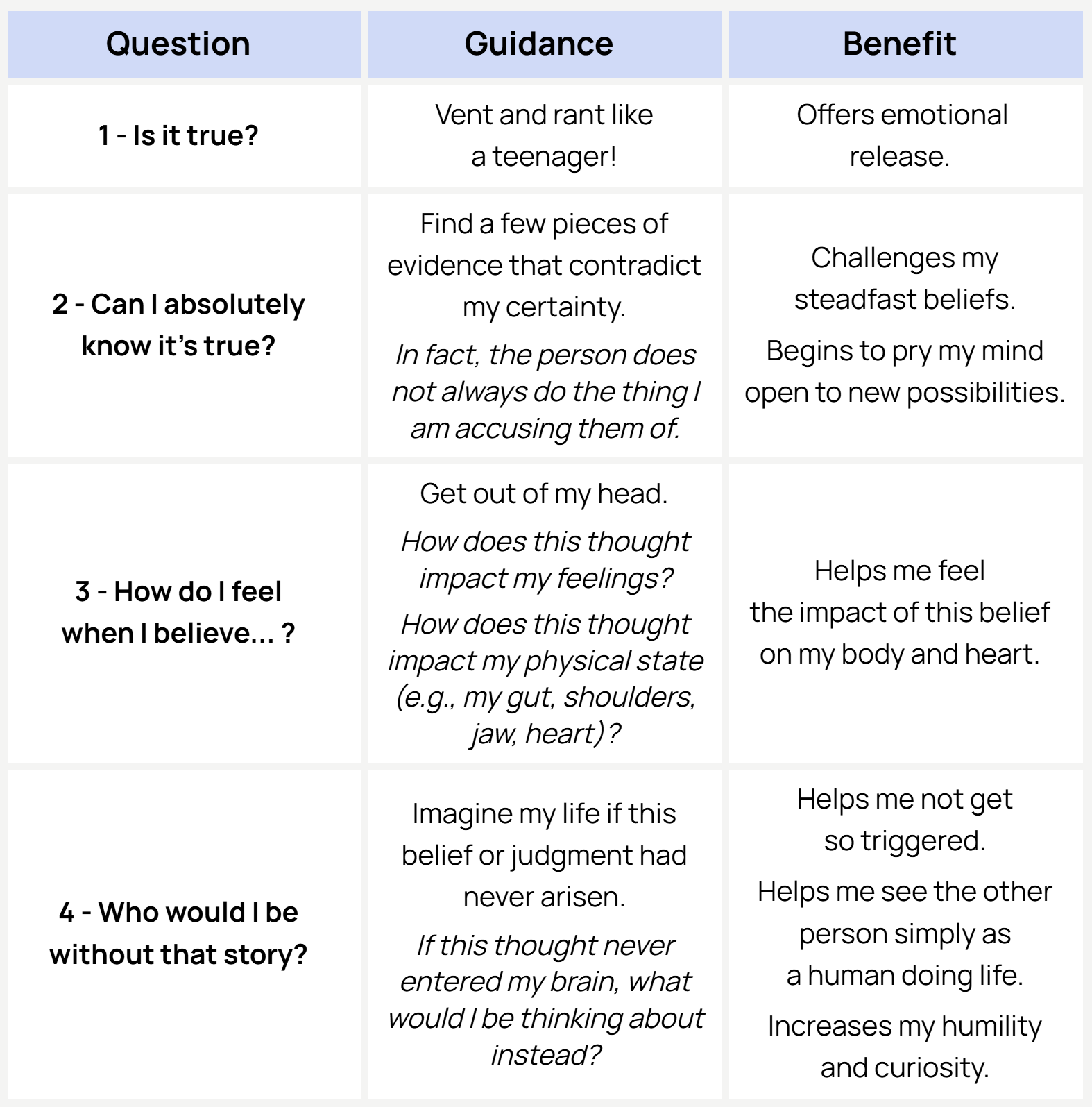
After talking with my friend Jim, I walked myself through the four questions:
1. Is it true?
“Is it true my friend is closed-minded?”
My answer came quickly: Yes! Plenty of evidence! Jim is planning to campaign door-to-door to convince people to see the world his way. He stays in his information bubble. He avoids political conversation with his brother. I let myself rant.
2. Can I absolutely know it’s true?
“Can I absolutely know it’s true that my friend is closed-minded?”
Honestly? No. Jim is curious about our workshop on bridging political divides. He genuinely wants to stay connected with his brother.
I didn’t come up with much contradictory evidence, but it was enough to slightly loosen my certainty. I trust this process, so I kept going.
3. How do I feel when I believe that story?
Heavy. Sad. Somewhat hopeless about the polarization in the U.S. And, underneath it all, scared. Scared that if I challenge him, he’ll pull away. Scared of rupturing the ease of our friendship.
4. Who would I be without that story?
Lighter. Braver. More willing to lovingly challenge him, rather than tiptoeing around the topic. I’d trust that our relationship could handle a hard question.
Where Real Insight Comes:
The “Turnarounds”
The final step in Byron Katie’s process is exploring the "Turnarounds": testing the original belief from different angles, including its opposite.
You don’t need to blame yourself or pretend the situation isn’t painful. The turnarounds give you a structured way to ask, “Could the opposite also be true? Is there another perspective I’m missing?”
A turnaround helps you loosen the grip of your original stressful thought by testing out alternative viewpoints and seeing which ones feel as true, or even truer.
For example,
Stressful thought: He doesn’t listen to me.
Turnarounds: I don’t listen to him. I don’t listen to myself. He does listen to me.
You explore each Turnaround with curiosity, looking for real-life evidence that opens up understanding rather than reinforcing a limiting story.
Turnaround #1: “I am the one who. . . ?”
“I am closed-minded.”
Ugh. How is this true? Well, I believe adamantly that the way forward in conflict is a collaborative approach—that every side has a kernel of truth in it, if we could only discover it. And that passion sometimes makes me resistant to people who don’t share that belief. I can get rigid about open-mindedness.
Turnaround #2: “He is. . .”
“My friend is open-minded.”
How is this true? Oh, wow. Here is where I remembered that Jim embraced his son when he came out as gay.
Seeing that broke open something in me. Suddenly, the story “he’s closed-minded” felt wrong. Unfair. Too small.
I felt genuinely curious. How did Jim move through those changes? What helped him? What could I learn from him?
A week after doing “The Work,” I phoned him to ask about his journey with his son. Here’s what he said, “I grew up in Oklahoma. We were intolerant of gays. We’d make dumb jokes as you do when you are a kid, but we never really thought about it. But as I began to consider the possibility that my son was gay—because I love my son, that was way more important than anything—I accepted it.”
He changed his mind. He changed his heart.
Our conversation was rich. I was so glad I reached out and got to know him more deeply.
Getting Off Your High Horse
Moving through this process helped me let go of my rigid thinking about Jim, soften my heart, and feel a bit more hopeful.
Each prompt promotes self-inquiry in a particular way. The prompts build on one another, helping us move from judgment to curiosity to, finally, a little more kindness towards ourselves and the other person.
Byron Katie’s Four Questions
Byron Katie’s Two "Turnarounds"
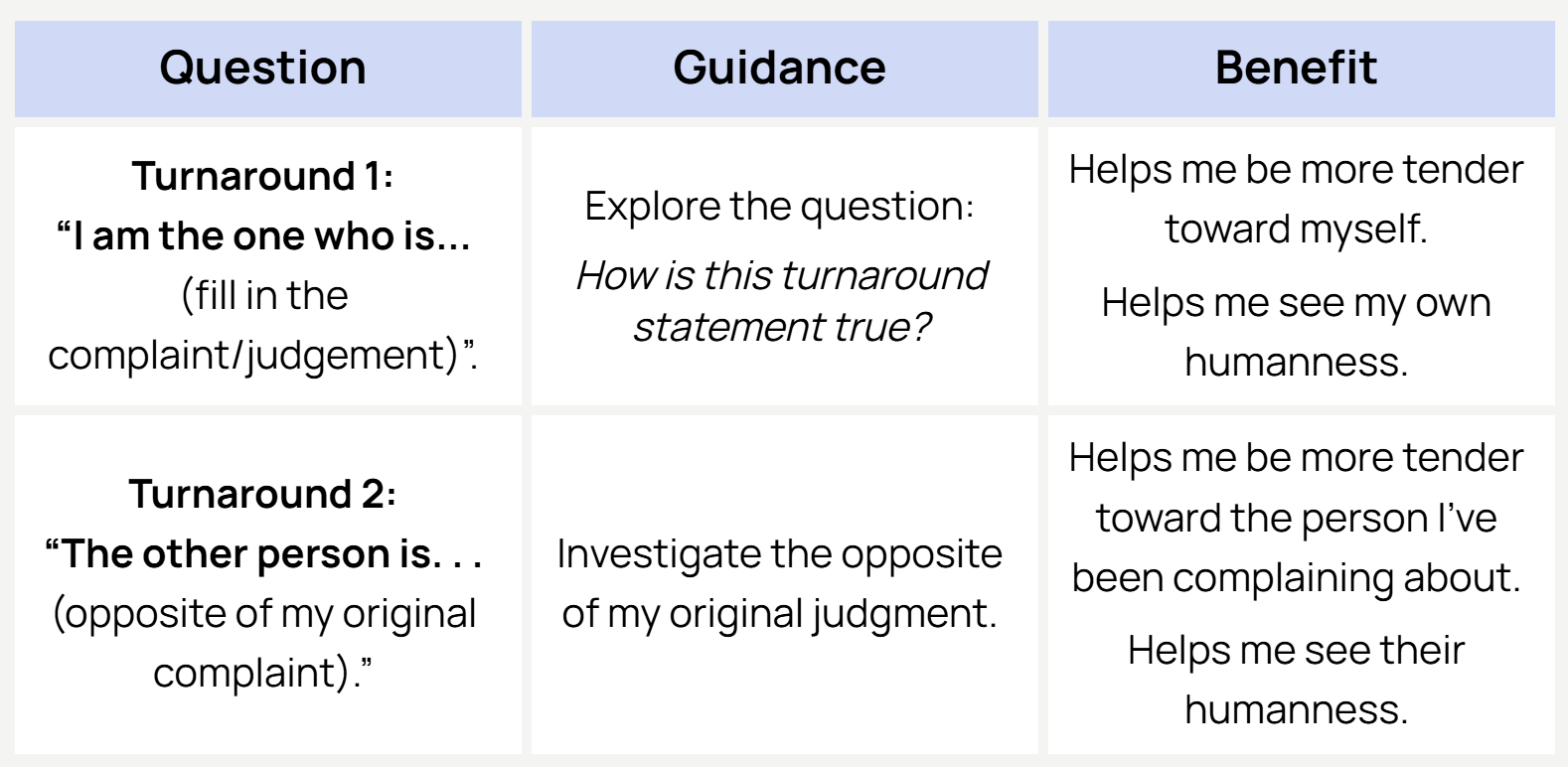
A word of caution: sometimes, long-time users of “The Work” want to jump straight to the Turnarounds. But it’s best to work through the four questions first, so you feel a little less certain, more humble, and more curious as you enter the exploration of the Turnarounds.
How This Approach
Helps Us Bridge Divides
Katie’s questions and turnarounds help us see others’ humanity, and our own.
I want people (including me) to stop being so certain that our beloveds are nonsensical, illogical, not thinking critically, or have turned off their brains. To stop being so sure that our beloveds are closed-minded. To start seeing how sometimes we are closed-minded.
“The Work” helps us to see beyond our political point of view.
A Blue might acknowledge that communities feel strained when systems are overwhelmed by immigrants.
A Red might recognize cruelty in certain immigration policy enforcement.
Both might remember that people on “the other side” also want safety, belonging, and dignity.
Together, we might go a bit deeper than the supposed Red/Blue divide and notice how U.S. policies have shaped the conditions that immigrants are fleeing.
Each time I use the questions and turnarounds, a few key shifts happen:
I see my own part in the dynamic.
My judgment softens into curiosity.
The other person becomes fully human again.
The conversation that felt daunting begins to feel possible.
Why This Matters:
The Macro Implications
of Our Micro Choices
Here's what I believe: If we can't talk with our beloveds—people we know are not assholes—then we have no hope of healing the polarization tearing our country apart.
The media won’t save us. They profit from outrage. The political parties won’t save us. They profit from division.
It is up to us. And that starts at our own dinner tables, with people we love.
If we write them off as closed-minded, if we avoid the discomfort of engaging in a conversation about our differences, we're doing exactly what the systems of polarization want us to do. We're letting fear win.
What If We Practiced
Challenging Our Certainty?
What if, instead of cutting people out of our lives or staying quiet and internally righteous, we paused and asked:
"What might I be missing?"
"What else might be true?"
Rather than focus on how to get others to change, I focus on how to change myself: my stories, my assumptions.
We don’t have to agree. But when we broaden our perspective, we can become more open, more curious and more connected. And maybe we can model a different way forward.
An Invitation
My brother Dane and I are collaborating on a passion project: “Reconnecting with Our Beloveds Across Political Divides.”
It’s a free, six-week online pilot workshop for those who’ve given up on talking about charged political issues or world views with a loved one, but haven’t given up on each other.
Let’s learn to move from drama to dialogue — and from division to deeper connection.
Learn more about the course here!
If this article resonated, sign up for our newsletter. We’ll share more tools for navigating hard conversations with heart — and stories about what happens when we dare to love across our divides.